TLDR
There are twelve million Java developers and the AI ecosystem built everything for Python first. LangChain4j fixes that.
You can wire up an LLM, give it tools (database queries, API calls, search), and let it decide which tool to use and when. That’s an agent, built in Java.
It handles prompt templates, chat memory, RAG pipelines, MCP support, and tool calling across 20+ LLM providers through a single API.
The Python Problem
There are twelve million Java developers on this planet, and the AI ecosystem decided Python is the only language that matters.
Every major LLM framework launched in Python first: LangChain, LlamaIndex, CrewAI, Haystack. The tutorials, the examples, the blog posts are all Python. If you’re a Java developer who wants to build with LLMs, the industry’s answer has been "learn Python" or "call a Flask endpoint."
That answer has always been wrong. Java runs the backend systems where AI needs to live: the banking platforms, the healthcare systems, the logistics engines, the e-commerce stacks. Asking those teams to bolt on a Python microservice for AI features means a second language, a second deployment pipeline, a second set of dependencies, and a second team to maintain it all.
LangChain4j is the library that says you don’t have to. Build and ship it in Java.
What LangChain4j Actually Does
LangChain4j is a Java library that connects large language models into your Java applications through a unified API. It supports 20+ LLM providers: OpenAI, Anthropic, Mistral, Google Vertex AI, Ollama for local models, and more. You pick your model, swap in a different one later, and the rest of your code stays the same.
Here’s the practical version. Say you’re building an internal tool at your company. Users ask questions about your data in plain English and get real answers back. With LangChain4j, you wire up an LLM, give it tools (a database query tool, a search tool, maybe an API call), and the model decides which tool to use and in what order.
That setup, where the model autonomously selects and chains tools to answer a query, is what the industry calls an agent. You just built one in Java without touching Python.
The Building Blocks
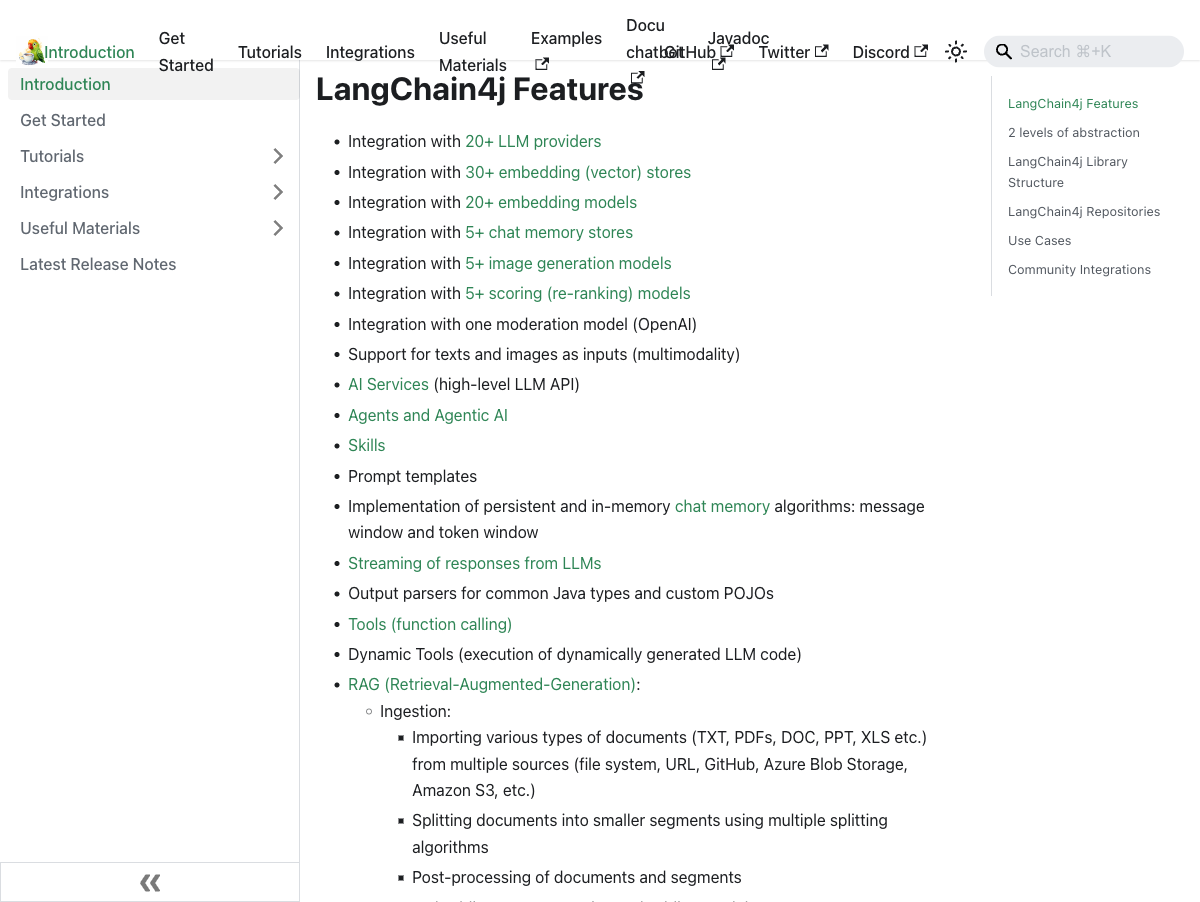
LangChain4j handles the infrastructure you’d otherwise write from scratch:
Prompt templates for structuring your inputs to the model
Chat memory so the model remembers what the user said three messages ago
RAG (Retrieval-Augmented Generation) pipelines for feeding your own documents into the model, with support for 30+ vector stores
Tool calling so the LLM can invoke your Java methods directly
MCP (Model Context Protocol) support for standardized tool integration
Structured output parsing so you get typed Java objects back, not raw strings
The API has three levels of abstraction. At the lowest level, you work directly with prompts and model responses. In the middle, you get helper classes for common patterns like chat, RAG, and tool execution. At the highest level, AI Services let you define a Java interface, annotate it, and LangChain4j generates the implementation that wires everything together. You write an interface. The framework handles the plumbing.
Agents in Java
The agent pattern in LangChain4j follows the ReAct loop (Reasoning + Acting) that most frameworks use. The model receives a query, reasons about what to do, picks a tool, executes it, reads the result, and decides whether to call another tool or return an answer.
What makes this work well in Java is that your tools are just Java methods.
You annotate a method with @Tool, describe what it does, and LangChain4j registers it with the model.
The LLM sees the description, decides when to call it, and your code executes on the JVM like any other method call.
If you need more complex agent workflows, LangGraph4j adds stateful graph-based execution with cyclic flows, checkpointing, and visual debugging. It works with both LangChain4j and Spring AI.
The Quarkus Connection
LangChain4j integrates well with Spring Boot, but the Quarkus integration deserves its own mention. Quarkus gives you dev mode with live reload, so you can iterate on your AI service the same way you iterate on a REST endpoint. Change a prompt template, hit save, and the running app picks it up.
The real payoff is native compilation with GraalVM. A LangChain4j service compiled to a native binary starts in milliseconds and uses a fraction of the memory. That matters when you’re deploying AI services at scale and paying for compute by the second.
The Quarkus + LangChain4j combination produces a production-ready AI service with the startup time of a Go binary and the ecosystem of Java. That combination deserves its own post, and it will get one.
Watch the Reel
I recorded a short video on this topic. The thesis is simple: I’m not settling for Python when Java does the job.
Why This Matters
The AI ecosystem’s Python bias created a real gap. Enterprise Java teams couldn’t participate in the LLM revolution without introducing a second language into their stack. LangChain4j closes that gap.
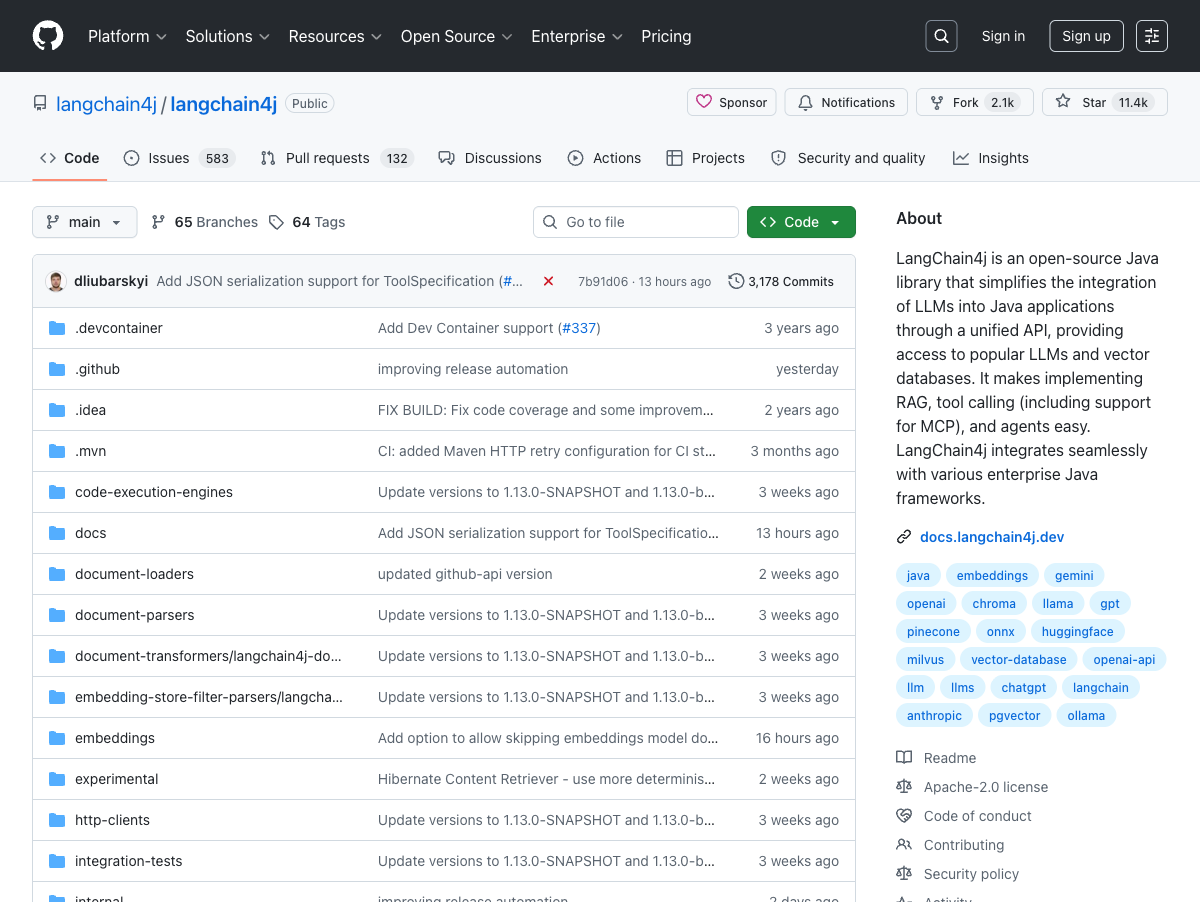
With nearly 12,000 GitHub stars, over 580 contributors, and a release cadence that tracks LLM provider updates within days, it’s the most actively maintained Java LLM library available. Google’s ADK for Java integrated with LangChain4j in 2026, which tells you where the ecosystem is heading.
Twelve million Java developers already know the best language for building production AI services. The rest of the industry is starting to catch on.